
Would you invite the “enemy” to dinner?
By Emiliano Rodriguez Nuesch and María Morena Vicente
When fear becomes constant, people don’t become more informed — they disengage. Not because they don’t care, but because constant exposure to suffering pushes the mind to shut down.
More headlines don’t fix that. They often make it worse.
What interrupts this kind of numbness is presence. Being in the same space. Using the senses. Relating to other people as people.
One of the oldest ways humans have done that is by sharing food.
Eating together slows us down. It moves us out of abstraction and into real interaction. Stories surface — where a dish comes from, who taught it, why it matters. “Them” becomes someone across the table.
That shift — from issues to people — is where empathy begins.
Here are a few inspiring examples from around the world.
During the Cold War, when Americans and Soviets were taught to see each other as enemies, Dr. Ruth Heifetz and other citizen diplomats tried something quietly radical: they invited people from both sides into their homes not for debates, but for dinner. As The Dinner Party at the End of the World describes it, the goal was simple — to replace fear and distance with real human contact. Around kitchen tables, strangers ate, laughed, and shared stories, and what began as awkward introductions slowly turned into genuine connection, as distrust softened not through arguments, but because eating together made each other human again.
In Nottingham, a Muslim-Jewish kitchen became a community space where neighbors cook and serve meals together. Over chopping boards and shared dishes, people discover what they have in common long before they talk about what divides them.
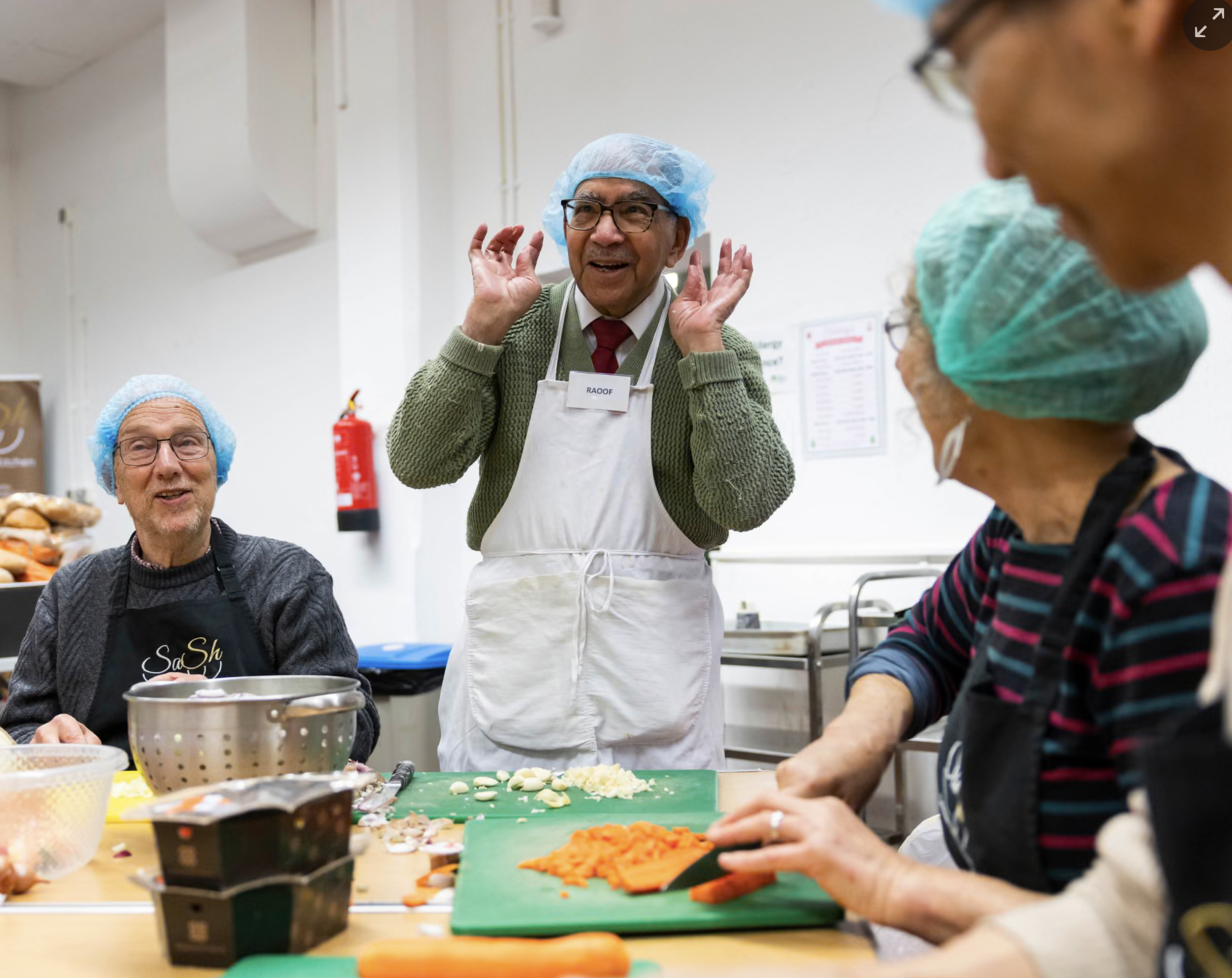
Photograph: Fabio De Paola/The Guardian.
Artist Michael Rakowitz’s Enemy Kitchen turns Iraqi recipes into a food truck where U.S. veterans and the public cook and eat together. The dish on the plate becomes a doorway into the story behind it — whose mother taught this recipe, whose village it came from — and suddenly “the enemy” feels human.
Across Europe, the Refugee Food Festival invites refugees to cook in local restaurants. Diners don’t just taste food — they taste someone’s home. Strangers become neighbors. Curiosity becomes compassion.
And the Peace-Meal initiative collects recipes and stories from people in conflict zones, showing how a shared meal can open conversations that politics never could.
In her TEDx talk “Food as Radical Empathy,” sociologist Alison Hope Alkon explains why food can interrupt numbness: it turns distant issues into shared, physical experience, making care feel possible again.
None of these initiatives solve war, polarization, or fear on their own. That’s not what they’re trying to do.
They do something more modest — and more psychologically important. They interrupt numbing.
They move people out of abstraction and back into presence. Out of headlines and into faces. Out of “us versus them” and into a shared table.
When suffering feels distant, we disengage. When it becomes human, we pay attention.
So the question isn’t whether a meal can bring peace.
It’s whether we’re willing to create the kinds of spaces — physical, social, emotional — where seeing the other as human becomes unavoidable.
Sometimes that space is a kitchen table.