
Lessons from the finish line
Near the end of the Boston Marathon, about 1,000 feet from the finish line, a runner collapsed.
Aaron Beggs was close by. He had been struggling for a while—feeling sick, running on empty, just trying to get through the final stretch. He could see the finish. He could have kept going.
Instead, he stopped.
“I looked at my watch, and I looked at him again, and the natural instinct was just to go and pick him up,” he said later.
Another runner, Robson De Olivera, joined him. Together, they lifted the man and moved him forward, step by step, until they crossed the finish line.
Beggs didn’t describe it as a decision. He described it as something that happened almost automatically. “It’s fight or flight,” he said. “And I decided to fight and help him get to our destination.”
Earlier in the race, he had been drawing on the crowd to keep going. The cheering along the course, especially near the end, had given him a second wind. “When I came down… the crowd started cheering,” he said. Then he turned the corner and saw the runner fall.
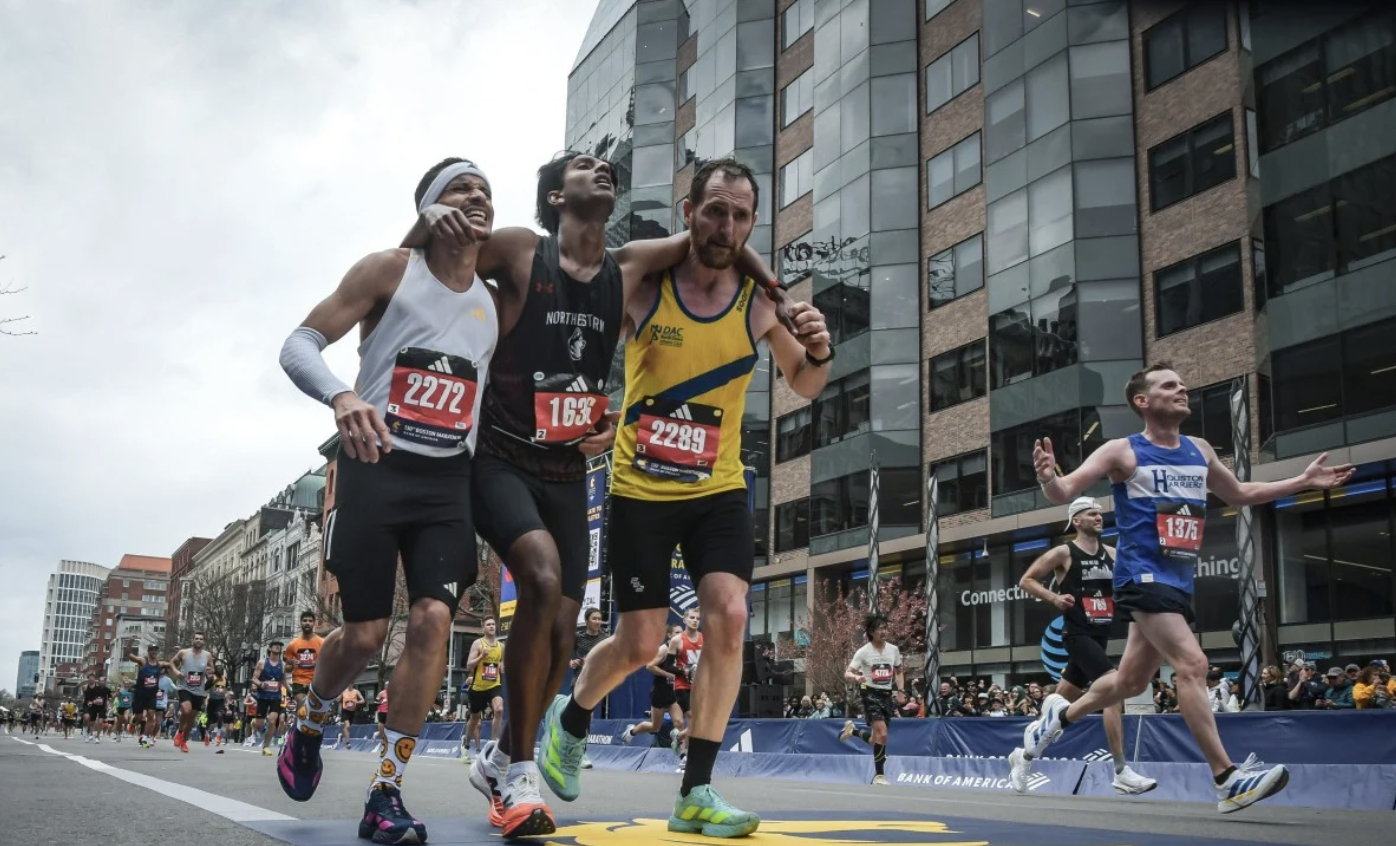
Ph.: Reuters
Marathons are competitive, but they don’t always feel that way. Runners talk to each other. They encourage each other. At some point, the race becomes less about beating the person next to you and more about finishing together.
“We’ve got this. Let’s do this together,” Beggs recalled saying to another runner along the way.
By the time he reached Boylston Street, that seemed to be the mindset he was in.
The moment itself was brief. There was no pause, no visible hesitation. He saw someone go down and went over. The rest followed.
Later, the three runners connected. Beggs said they had been in touch, and that he hoped to meet up again. “Three strangers, three different countries,” he said. “We’ll have a story for the rest of our lives.”
The video spread quickly online. It was shared as an example of sportsmanship, or kindness, or something larger. Beggs kept his explanation simple.
“It’s nice to be nice,” he said.
It’s an easy line to dismiss. But it also says something about how these moments happen.
He wasn’t at his best physically. He was tired, focused on finishing, thinking about his own race. And still, when something happened in front of him, helping didn’t seem to require much thought.
If anything, the shared experience of the race may have made the response more immediate. They had all come through the same course, the same effort, the same final stretch.
When one of them couldn’t continue, the others stepped in.
Not as a grand gesture but as something that, in that moment, felt natural.