
Keeping Toni Warm
By María Morena Vicente and Emiliano Rodríguez Nuesch
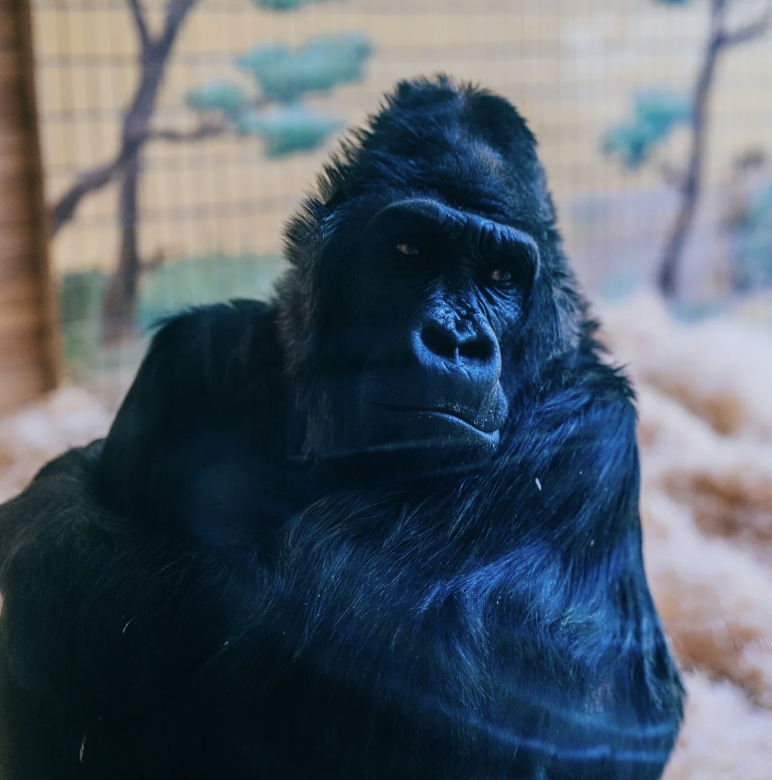
In Kyiv, winter has fallen to -22°C. Electricity comes only a few hours a day. Russian strikes have damaged energy infrastructure across the city. Half a million people are without power.
Inside the Kyiv Zoo, staff are trying to keep one room at 17°C.
That room belongs to Toni, Ukraine’s only gorilla.
At 52, Toni is old by western gorilla standards. He has lived at the zoo for a quarter of a century. Since Gorillas are native to the lowlands of central Africa, they are not built for Ukrainian winters.
When the power goes out, the heating stops. Within three or four hours, the temperature drops sharply. The zoo has to adapt to keep Toni alive.
Generators hum when fuel is available, and wood-burning stoves are fed through the night with logs gathered from the zoo’s own grounds. A barrel-shaped convection heater pushes warm air into Toni’s enclosure while staff rotate in shifts to monitor the temperature. Electricians, keepers, and kitchen workers move in and out, with twenty to forty employees on duty at any given time.
War and a zoo are not compatible. The zoo’s director explains that the mission is simple: keep the war outside the fence.
But the war does not stay outside.
Explosions have shattered glass panels near the terrarium. A crocodile and a turtle were injured by flying shards. A deer’s jaw was broken and Sections half of the zoo’s glass is already gone.
And still, the stoves burn.
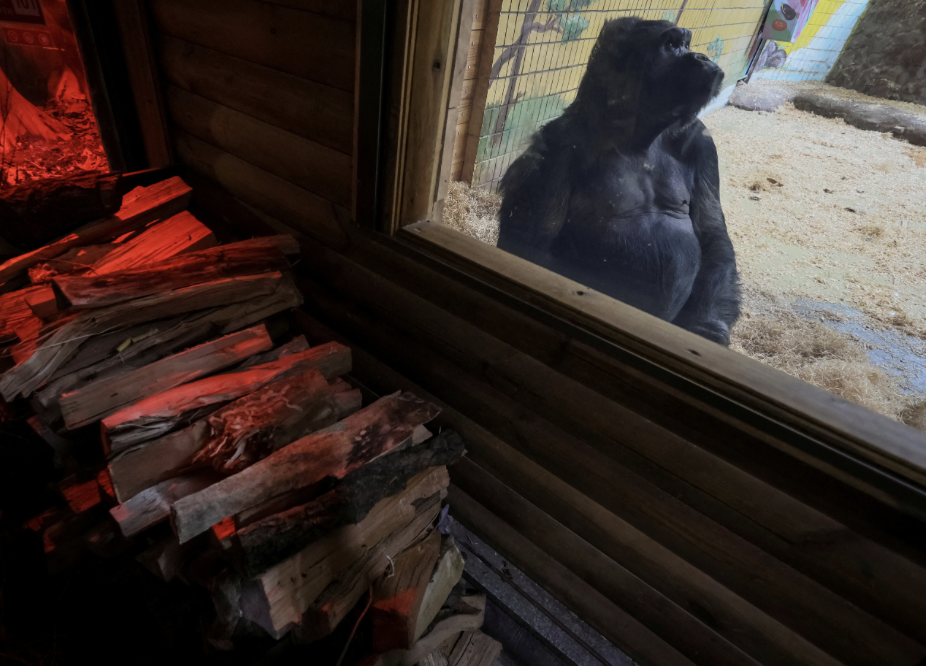
Creator: GLEB GARANICH. Credit: REUTERS
There is something easy about feeling empathy for a gorilla. Toni lies on his back and watches television. Children stand in front of the enclosure, looking up in silence. Soldiers recently released from Russian prisons visit as part of rehabilitation programs.
Toni is not a symbol by choice, but he has become one.
His vulnerability makes something visible. War does not only affect soldiers and infrastructure. It seeps into kitchens, into classrooms, into enclosures that were meant to be safe. It turns temperature into a matter of survival.
When staff choose to gather wood at midnight so that a 52-year-old gorilla can stay warm, they are asserting something simple: even in war, care continues.
In extreme conditions, what we choose to protect says something about who we are.